













2026.02.25 2026.02.25
Note: The Japanese version of this article can be read here (日本語). This is the original English version.
A tale as old as the last algorithm update. At Bruce Clay Japan we live and breathe SEO, meticulously following every guideline, best practice, and occasional cryptic tweet from a Google Search Advocate. But what happens when even Google accidentally breaks one of its own rules on its own site?
Oh believe me, it happens.
目次
What the heck is SEOdin?
A portmanteau of SEO and Odin, get it? That’s lame? Oh, well…
Anyway, we recently updated our Chrome extension, SEOdin Page Analyzer, a trusty sidekick (in my biased opinion), ready to analyze any webpage you visit. It checks technical SEO elements like structured data, canonicals, and (most importantly for this story) hreflang links.
You can grab the extension here.
developers.google.com
In my quest to analyze the web (and test this browser extension), I decided to point SEOdin at a very familiar place, the Google Developers site itself. You know, the site that tells you how to do SEO (and other [more] important things) correctly.
What’s that? https://developers.google.com/?hl=es-419 returns a 200 OK but “the country code for this link’s hreflang is invalid?”
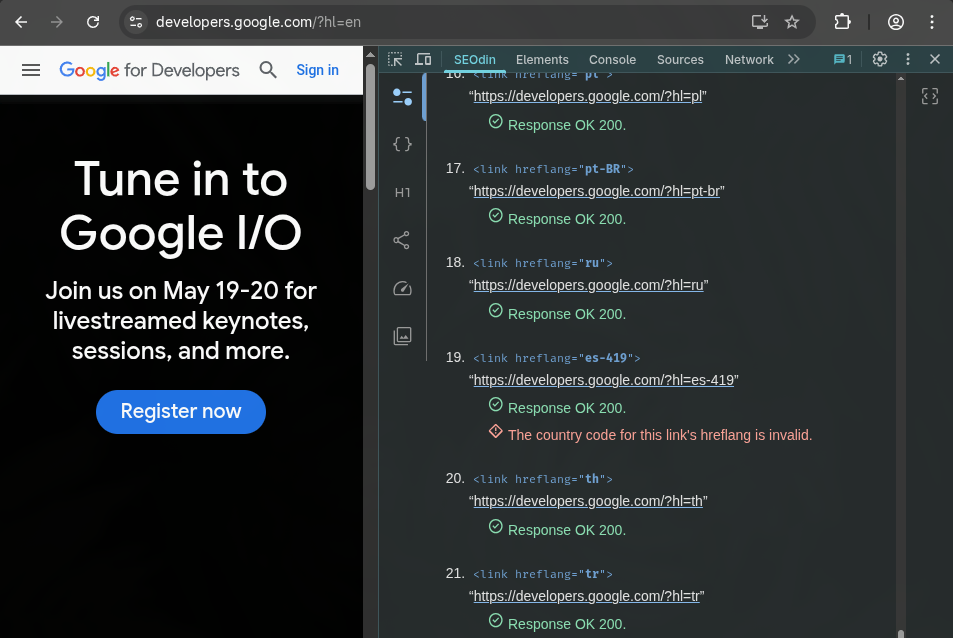
That’s weird, maybe my code is faulty. Let’s check the docs…
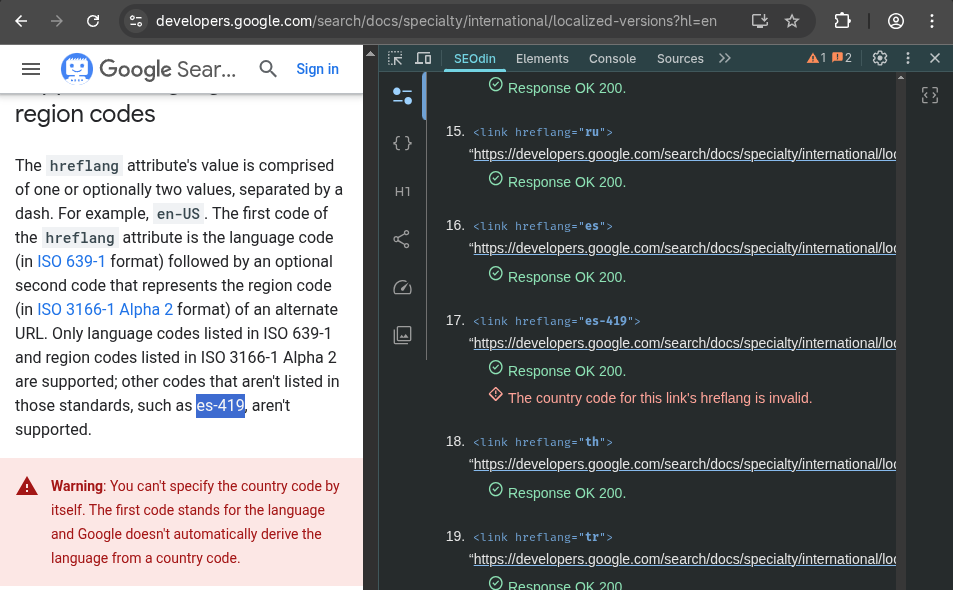
Thank Odin, an actual “that’s a feature, not a bug” in the world of SEO and software development.
No es-419 allowed, sorry Latin America
The specific rule in question is laid out right there on the documentation page: “Only language codes listed in ISO 639-1 and region codes listed in ISO 3166-1 Alpha 2 are supported; other codes that aren’t listed in those standards, such as es-419, aren’t supported.”
Don’t use es-419. It’s not a supported hreflang code.
To my delight, SEOdin pointed out that Google’s own site mentioning this code as being unsupported was using this unsupported code.
The difficulties of global SEO
It’s a good chuckle for us all. Even Google has trouble with SEO (if you’re Google, hit me up and we can help you out 🙂). It just goes to show how complex and easy it is to miss a small detail, even when you wrote the manual.
On a more serious note, this illustrates two key points:
- SEO, especially on an international scale, is brutal. Things like
hreflanglinks are notoriously tricky. If the people who created the standard can slip up, anyone can. - You have a watchful friend in Bruce Clay Japan and a free tool like SEOdin Page Analyzer. This is where our extension shines. While a human might quickly scan the code and miss a tiny, unsupported tag like
es-419, this extension will meticulously compare the page’s code against the official ruleset. It’s a technical safety net for finding these hidden issues.
Did I Mention It’s Free?
I hope you enjoyed this lighthearted look at a tiny slip-up by the web giant. If you want to keep your own site squeaky clean and avoid any embarrassing (and sometimes site-destroying) slip-ups that even Google can make, download the SEOdin Page Analyzer today and start scanning your site for technical errors.
If you or your team needs more integrated and deeper assistance with SEO, please contact us (unless you speak English; in that case, contact U.S.).
Keep up the good work.

Warren Halderman


BCJメールマガジンのご登録
最新のセミナー情報やお役立ち情報をメールにてお届け致します!
-

SEO・LLMOのプロが今、一番「危機感」を抱いていること──AIが「正解」を奪う時代の終着点
2026.03.25
View more
-

ゼロクリック時代のメディア生存戦略!PV至上主義を捨てず「独自の価値」で流入を掴む3つの基準
2026.03.13
View more
-

AI時代のSEOシミュレーションは「前年比」を疑え。ブルースクレイが提示する「真実の目標」とは?
2026.03.06
View more
-

SEOコンサル・広告代理店の仕事内容は「施策」だけじゃない──成果を左右する、表に出ない仕事の話
2026.02.10
View more
-

【サイト改善事例】カテゴリ修正とタグ追加で、既存コラムの検索順位が改善した理由
2026.02.10
View more
-

Googleが自らのルールを破る時:Google for Developersの「SEOやらかし」を暴く!
2026.02.03
View more